
India
BDSM in India: A Consent-Focused Guide
What BDSM actually means, how it gets understood and misunderstood here, and where to go next — whether your question is about consent, community, privacy, the law, or your own city. Start wherever your question actually is.
Last reviewed:
In short
What does BDSM look like in India?
BDSM is an umbrella term for a wide range of consensual interests and relationship dynamics between adults — not one activity, and not a personality type. In India most of it happens quietly: inside relationships you would never guess at from the outside, in reading done late at night, and through a small number of low-profile communities in the bigger cities. Consent, privacy and being able to say the thing out loud matter far more here than any technique. And if you are reading this at 2am wondering whether you are the only person in the country who feels this way — you are not, and it is not close. This site is educational. It does not arrange introductions, provide services, or put you in touch with anyone.
What BDSM means — and what it does not
Four letters, several different things stuffed inside them: bondage and discipline, dominance and submission, sadism and masochism. Almost nobody wants all of it, and you are not required to. What usually happens is that one narrow slice of it describes something you have felt for years and never had a word for. The rest is other people's business. Take the one thing that made you sit up and leave the rest on the shelf.
- BDSM
- An umbrella term for consensual practices and relationship dynamics between adults involving negotiated authority, structure, restraint, sensation or role — agreed beforehand, revocable the second either of you wants out, and marked off from ordinary life by an explicit understanding rather than an assumption. The longer version is in what BDSM means.
The load-bearing word there is negotiated. What separates any of this from simply being treated badly is that the two of you talked about it while calm and fully dressed, agreed what would and would not happen, and both kept the ability to stop it dead. That is the whole architecture. Take it away and you are not looking at BDSM any more. You are looking at something else, and it already has a name.
Myth
It is just a polite word for abuse.
Reality
Abuse is defined by the absence of consent and by taking away your ability to leave. A negotiated dynamic is defined by the exact opposite: you can end it, and both of you know that. Reviewing the literature on consent in BDSM, Dunkley and Brotto place informed, mutual, ongoing consent at the centre of precisely this distinction. It is not a difference of degree. It is the whole thing. BDSM and abuse are not the same works through the warning signs.
Myth
It is what you have seen in pornography.
Reality
Pornography is made to be watched. It compresses time, cuts the negotiation, and shows you none of the conversation that would make the same scene workable between two actual people who have to see each other on Sunday. Treating it as an instruction manual is the single most common reason a first attempt goes badly.
Myth
People who want this must have been damaged somehow.
Reality
This is the one you probably arrived carrying, and it is the one worth putting down first. A systematic scoping review by Brown, Barker and Rahman in the Journal of Sex Research found little support for psychopathological models of BDSM, and reported that fantasies of this kind are common in the general population rather than rare. Wanting this is not evidence that something was done to you. Curiosity is not a symptom, and you do not owe anyone an explanation for your own imagination.
Myth
It is something you book.
Reality
Paid services exist and are a different subject entirely. This site is educational. We do not review, list, verify or link to providers, and nothing here is a route to one. If that is what you were looking for, you are in the wrong place, and we would rather say so than let you waste an evening.
What actually gets in your way in India
Any sentence beginning "in Indian society, people think…" is going to be wrong somewhere. A Malayali family in Kochi and a Punjabi one in Ludhiana are not running the same rules, and your household is not running either of them exactly. But a few pressures come up again and again, and they happen to be the ones most writing on this subject cheerfully assumes away.
Start with how close everyone is to you. Plenty of unmarried adults here live with parents well into their thirties, and plenty of married ones live with in-laws. Add a flatmate, a maid with a key, the neighbours in your society who somehow know exactly who came and when, and the relative who arrives without calling. The amount of genuinely unobserved space in an ordinary Indian life is tiny. It does not stop you having an inner life. It just means the distance between quietly knowing something about yourself and doing anything at all about it can run into years. If that is where you are — knowing, and stuck — you are in extremely ordinary company. You are not failing at this.
Then there is the vocabulary. It reached most of us through the internet rather than through anything continuous in our own culture, which produces a particular sequence: you recognised the feeling long before you found the word. Sometimes decades before. When the word finally arrives, the relief can knock the wind out of you — there is a name, other people have it, you were not making it up. It can also tip the other way, into adopting an entire framework and a label within a fortnight of learning either exists. Neither reaction tells you much about what you will actually want in two years. Let it settle.
Consent, boundaries and healthy power exchange
Consent here is a stricter standard than the everyday sense of the word, and it is also the most interesting part. Not one yes, collected once, filed away, covering everything that follows. Something closer to a conversation you keep having — including the part where you say what you want out loud and find out that saying it is half the charge.
Key points
- Specific, not general. Agreeing to one thing is not agreement to whatever happens to be standing next to it. You decide the scope in advance; nobody gets to assume it afterwards.
- Ongoing and revocable. Your yes from last week does not roll over automatically. Stopping halfway through needs no reason, no apology and no good timing.
- Capacity matters. Nobody well past a couple of drinks can meaningfully agree to something new, including you. Alcohol is where a great many otherwise careful arrangements quietly come apart.
- Authority is lent, not signed away. If you are the one following, you keep the ability to end it — that is not a loophole, it is the load-bearing wall. Anyone selling you an arrangement without it is not offering a deeper version of the same thing. They are offering a different and worse thing.
- Afterwards counts. The next hour — a hand on your back, something to eat, a stupid conversation about nothing — is not sentiment bolted on the end. It is how you both come back down, and skipping it is how something lovely turns into something you feel odd about on Tuesday.
Is there a BDSM community in India?
Yes — with qualifications that matter more than the yes does. Discussion groups, occasional in-person socials and long-running online spaces exist in the larger cities, and they are documented rather than rumoured: Indian outlets including The Established and The Wire have reported on these networks, and Kinky Collective, a volunteer group raising awareness about kink, has been running since the 2000s and held a BDSM-themed photo exhibition in Delhi as far back as 2013. People have been quietly doing this here for longer than you have been wondering about it.
What it does not mean is that there is a door you can walk through this weekend. Access runs through people rather than sign-up forms, so you will usually get in via somebody already inside — and being checked out first is normal, not an insult aimed at you. It is also concentrated in a handful of cities, which means "is there a community in India" and "is there one where I live" can have very different answers. Quality varies enormously. A well-run group with clear norms and a working way to raise a problem is genuinely good for you. A badly run one recreates the exact dynamics its members will tell you, at length, that they escaped.
We keep no list of groups, venues or events. That kind of thing goes stale within months, and sending you to an organiser who stopped three years ago is worse than sending you nowhere. How BDSM communities in India actually work covers the ecosystem, the etiquette, and the usual route in.
How you actually find like-minded adults
There are only a handful of routes in, and each one fails in its own particular way. Knowing which one you are on, and what tends to go wrong with it, is most of the safety conversation right there.
| Channel | Where it works | What to watch for |
|---|---|---|
| An existing partner | Much the most common route, and the one where the trust already exists. Finding them was never your problem. Saying it out loud is. | Raising it badly — as an ultimatum, or in the middle of a fight. Timing and framing do most of the work. |
| Community groups and socials | Meeting people clothed, sober and in public first. Reputation exists, so behaviour has consequences. | Access is slow and social. Think months, not evenings, and expect to be checked out. |
| Dating and community apps | Numbers, and the freedom to say plainly what you want instead of hinting at it for six weeks. | The highest rate of misrepresentation anywhere: fake profiles, hidden marriages, and paid services dressed up as personal interest. |
| Someone vouching for someone | The best filter available, because a person is putting their own standing behind it. | Requires already knowing somebody, which is exactly what you do not have at the start. |
| Workshops and talks | Learning one specific thing with nothing else expected of you, which takes the pressure off completely. | Rare outside the biggest cities, and only as good as whoever is running it. |
One ambiguity is worth naming outright, because it will save you an evening. A good share of what comes back when you search these words here is commercial, whether or not it admits it. Decide before you start whether you are looking for a person or a service. The two look nearly identical in a list of search results and nothing like each other by the time you are sitting across from someone. Finding like-minded adults safely goes through this properly, exploring BDSM near you covers what a location search actually returns and how to read it, and privacy and BDSM in India covers what to share and when.
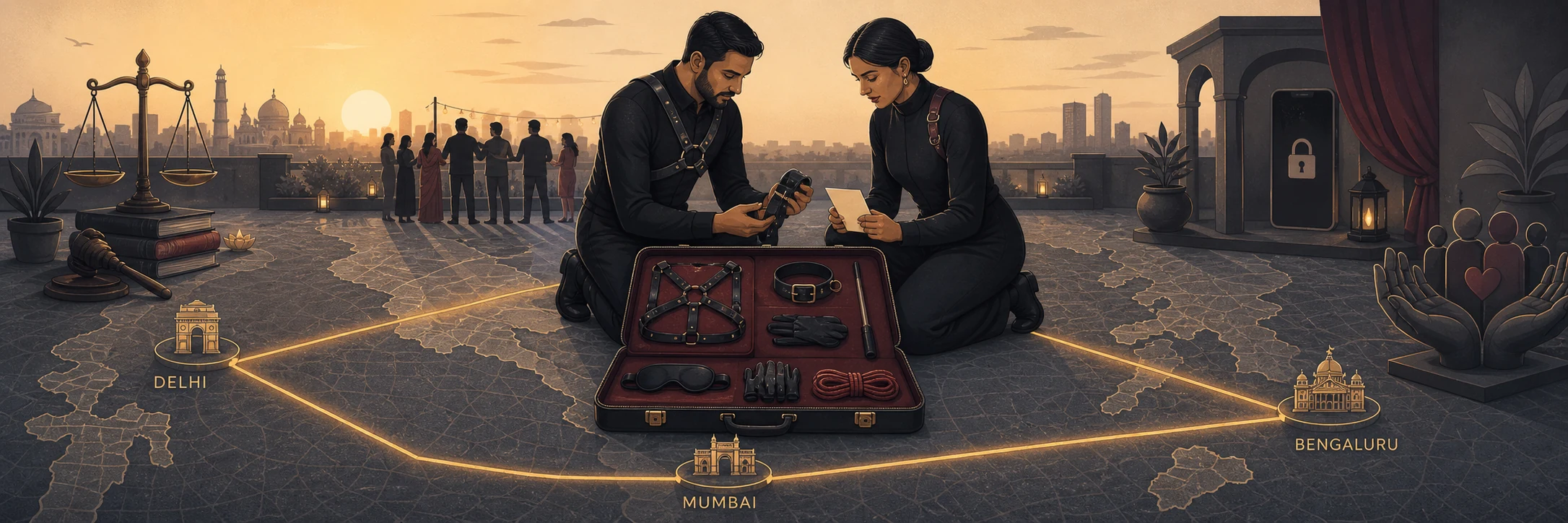
BDSM in Delhi, Mumbai and Bengaluru
Three cities get guides of their own, because they differ enough that national advice would mislead you in each of them. Find yours below, or the nearest thing to it.
Delhi and the NCR
More people search these words in Delhi than in any other Indian city, and more commercial noise is mixed into the results — so telling the two apart is a practical skill you will need here rather than an abstract worry. The NCR's geography works against you at every turn: Gurugram to Noida is an expedition, so people meet less often and give away less early on. Privacy runs the show, especially if you are in a barsati or a PG where you do not control who has a key to your own room. BDSM in Delhi.
Mumbai
Mumbai has the most visible social and editorial ecosystem of the three, helped along by an arts and performance crowd who stopped finding unusual interests remarkable earlier than everyone else. It is also where you will find it hardest to be physically alone: shared flats well into adulthood, chawl and society living where the neighbours clock everything, and a commute that turns a weeknight meeting into a project with milestones. Rope and Shibari interest runs deeper here than anywhere else in the country. BDSM in Mumbai.
Bengaluru and Bangalore
Bengaluru skews younger and far more transplanted. If you moved here for a job, you may be living away from family for the first time, which loosens the privacy problem considerably and makes everything else more transient — the person you finally click with may be relocating in March. There is real rope and structured-practice interest, and a noticeable habit of negotiating in writing, which is not unconnected to who works here. Both names are in ordinary use and neither is more correct. BDSM in Bengaluru.
Kink and BDSM are related, but not identical
The two words get swapped around constantly, and the confusion is avoidable. Kink is the wider category — any sexual or sensual interest outside the conventional default, which is a much larger tent than you think and you are already standing in it. BDSM is one well-mapped region inside that tent: the part about authority, structure, restraint and sensation between consenting adults. Plenty of kinks have nothing to do with power at all. And plenty of D/s relationships involve almost none of what you pictured when you first heard the word.
The distinction earns its place for a practical reason: the Indian conversation about kink is broader and more cultural than the one about BDSM specifically, and the two will hand you different questions. Kink in India covers that wider picture, while BDSM, kink and fetish compared sorts out the definitions.
Privacy and discretion in India
Your real constraint is almost never the law, and it is not community access either. It is a phone that backs up to an account somebody else can open on a laptop in the next room. Ten minutes of carelessness, far more than anything else, is what turns a private matter into a family one.
Is BDSM legal in India?
No Indian statute names BDSM and declares it lawful or unlawful, so you are not going to get a clean yes or no — and anybody handing you one is oversimplifying. What applies to you is ordinary criminal law. The Bharatiya Nyaya Sanhita, 2023, which replaced the Indian Penal Code from 1 July 2024, sets out general exceptions around consent, along with the provisions on hurt and grievous hurt and on obscene acts in public.
Where should you start?
Three routes, depending on which question is actually yours tonight. None of them involves meeting anybody. None of them asks you to decide anything about yourself, or to call yourself anything. You can read all three and still tell no one.
If you want to understand the basics
If you are trying to understand yourself
Key takeaways
Key points
- BDSM is an umbrella term for a range of consensual dynamics between adults — not one activity, and not a personality type. You can want one slice of it and none of the rest.
- What separates it from mistreatment is negotiation, stated limits and a retained ability to stop. Never intensity.
- Research reviewing the field has found little support for the idea that an interest in this indicates psychopathology. You are not broken.
- Communities and socials do exist in the larger Indian cities and are documented in Indian media, but you get in through people rather than through a door, and quality varies.
- What will bind you is privacy and your living arrangements, not the law.
- Indian law has no BDSM-specific provision. Consent is not a blanket defence, particularly where injury is involved.
- Delhi, Mumbai and Bengaluru differ enough that national advice would mislead you in each of them.
Self-assessment
Trying to work out where you sit?
The Dom/Sub/Switch test is a private, educational self-assessment. Nothing you answer leaves your browser — there is no login, no storage, and no result in the URL or in any analytics.
Have a question you would rather ask privately?
Connect is a private way to reach the people who write this site. It is not a dating, matchmaking or introduction service, and there is no public profile.
Sources
Ministry of Law and Justice, Government of India — The Bharatiya Nyaya Sanhita, 2023 (Act 45 of 2023)2023-12-25
Supports: That there is no BDSM-specific provision in Indian criminal law; the general exceptions concerning consent and their limits; in force from 1 July 2024.
The Journal of Sex Research — Brown, A., Barker, E. D., & Rahman, Q. — A Systematic Scoping Review of the Prevalence, Etiological, Psychological, and Interpersonal Factors Associated with BDSM2020
Supports: That the literature provides little support for psychopathological models of BDSM, and that fantasies of this kind are common rather than rare.
Sexual Abuse — Dunkley, C. R., & Brotto, L. A. — The Role of Consent in the Context of BDSM2020
Supports: That informed, mutual and ongoing consent is the distinguishing feature between consensual BDSM and abuse.
The Established — How kink is being normalised in India
Supports: That kink and BDSM communities, munches and events exist in India and have become more visible — reported, not inferred.
Kinky Collective — Kinky Collective — raising awareness about kink in society
Supports: That a long-running Indian volunteer group doing kink awareness and education exists, including a BDSM-themed photo exhibition held in Delhi in 2013.